
Updating an Ubuntu server with tui-update, one package held back
Fifty updates pending, most of them security fixes, a kernel among them, and one package you would rather not move today. One walk through tui-update over SSH, from holding that package to the plan, the non-interactive upgrade and the reboot it owes.
Everything below was run on 2026-11-18 on an Ubuntu 24.04.5 LTS virtual
machine from the stock cloud image (apt 2.8.3, needrestart installed), with a
build of tui-update from its main branch ahead of 1.0.0. The image had fallen
behind on its updates, which is the point: 50 were pending. The tool ran as an
ordinary user, lab, in a terminal reached over SSH, and escalated with
sudo -n. The screens and dialogs are copied from the terminal, without the
dialog borders and with the runs of spaces in wide tables shortened; nothing in
them was retyped. The screenshot is the tool’s own, from --demo.
Install and open it
$ sudo apt install tui-updateThe repository setup is on the install page. tui-update reads the package lists as they are when it opens (the upgrade itself refreshes them as its first step), so refresh them first if they are old:
$ sudo -n apt-get update -qq$ tui-updatetui-update apt via /usr/bin/sudo -n on ubuntu updates: 50 pending security: 38 restart: reboot snapshot: no backend: apt 2.8.3 PACKAGE CURRENT → NEW REPO SEC linux-headers-generic.amd64 ·k 6.8.0-147.147 → 6.8.0-149.149 noble-updates… yes linux-image-virtual.amd64 ·k 6.8.0-147.147 → 6.8.0-149.149 noble-updates… yes libc6.amd64 ·c 2.39-0ubuntu8.9 → 2.39-0ubuntu8.12 noble-updates… yes cloud-init.all 26.1-0ubuntu1~24.04.1 → 26.2-0ubuntu1~24.04.2 noble-updates —
·k marks a kernel and ·c a core library: the two kinds of package that
decide whether the machine needs a reboot afterwards. restart: reboot in the
header is that verdict for the whole list.
Hold one package back (H)
/ and cloud-init filter the list down to one row. H on it:
Hold cloud-init at its installed version, so no upgrade touches it until the hold is lifted
Hold cloud-init at its installed version, so no upgrade touches it until the hold is lifted.
A held package stops receiving updates, security fixes included, until the hold is lifted.
How: held with `apt-mark hold`, which is the dpkg selection every apt front end honours.
Command to run:
$ /usr/bin/sudo -n /usr/bin/setsid -w apt-mark hold cloud-init
After y, the status line said cloud-init set on hold. and apt-mark showhold printed cloud-init. H on the same row lifts it.
The plan (enter)
/ and an empty filter bring the whole list back. enter shows what applying
it would do, before anything runs:
Upgrade 50 package(s) with apt, 38 of them security fixes
Restart classification
class          reboot
decided by     needrestart -b
Upgrade mode
upgrade  (m cycles: upgrade → dist-upgrade)
Snapshot before
snapshot before: no
snapper has no root configuration, so the root subvolume cannot be snapshotted
The commands, in order
1. /usr/bin/sudo -n /usr/bin/setsid -w apt-get update
   Refresh the apt package lists
2. /usr/bin/sudo -n /usr/bin/setsid -w env DEBIAN_FRONTEND=noninteractive NEEDRESTART_MODE=a apt-get -y -o Dpkg::Options::=--force-confdef -o Dpkg::Options…
3. (nothing) — tui-update never reboots by itself
apt dry run
The following upgrades have been deferred due to phasing:
  snapd
The following packages have been kept back:
  cloud-init linux-headers-generic linux-headers-virtual linux-image-virtual
  linux-virtual
The following packages will be upgraded:
  apt apt-utils bind9-dnsutils bind9-host bind9-libs ca-certificates
Read the dry run, not only the headline. upgrade adds and removes nothing,
so it keeps back the kernel metapackages, whose new versions need new
packages, as well as the held one; and apt holds snapd back on purpose
while Ubuntu phases its rollout. The headline still counts all 50, and the
reboot reason names the kernel; that is filed as
tui-update#35. m switches
to dist-upgrade, which would take the kernel too.
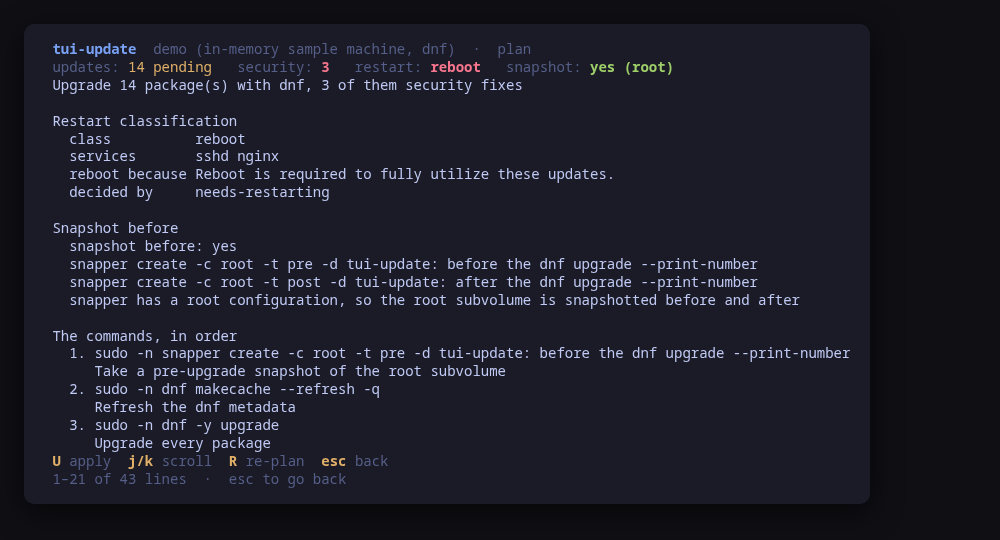
Apply it (U)
Upgrade 50 package(s) with apt, 38 of them security fixes
No snapshot: snapper has no root configuration, so the root subvolume cannot be snapshotted.
apt asks nothing: debconf takes its defaults, needrestart restarts the services left on replaced libraries, and a config file changed on this machine
keeps the local version, and the package's new one is left beside it as .dpkg-dist.
tui-update never reboots by itself.
Command to run:
$ /usr/bin/sudo -n /usr/bin/setsid -w apt-get update
$ /usr/bin/sudo -n /usr/bin/setsid -w env DEBIAN_FRONTEND=noninteractive NEEDRESTART_MODE=a apt-get -y -o Dpkg::Options::=--force-confdef -o
Dpkg::Options::=--force-confold upgrade
After y the output scrolls on the same screen. Nothing stops to ask: no
debconf question and no needrestart menu, which is what a terminal that is
not there would otherwise wait on forever. It ended on:
 No VM guests are running outdated hypervisor (qemu) binaries on this host.
✓ done
The sequence finished. A reboot is needed afterwards: linux-headers-generic 6.8.0-147.147 → 6.8.0-149.149; linux-headers-virtual 6.8.0-147.147 → 6.8.0-149.14…
j/k scroll  R reboot  esc back
upgrade finished
The reboot, only when you say so (R)
Reboot the machine
The upgrade replaced code nothing running will pick up until the machine has restarted.
Why: linux-headers-generic 6.8.0-147.147 → 6.8.0-149.149; linux-headers-virtual 6.8.0-147.147 → 6.8.0-149.149; linux-image-virtual 6.8.0-147.147 →
6.8.0-149.149; libc-bin 2.39-0ubuntu8.9 → 2.39-0ubuntu8.12; libc6 2.39-0ubuntu8.9 → 2.39-0ubuntu8.12; zlib1g 1:1.3.dfsg-3.1ubuntu2.2 →
1:1.3.dfsg-3.1ubuntu2.3
Every session on this machine, including this one, ends here.
Command to run:
$ /usr/bin/sudo -n /usr/bin/setsid -w systemctl reboot
The reboot was owed: /var/run/reboot-required.pkgs named libc6. The
kernel lines in the reason are the ones apt kept back (see above). After y
and the reboot:
$ ls /var/run/reboot-required; apt-mark showhold; tui-update --check | grep -E '"(backend|pending|security|restart|rebootRequired|holds)"'ls: cannot access '/var/run/reboot-required': No such file or directory cloud-init "backend": "apt", "pending": 6, "security": 4, "rebootRequired": false, "restart": "reboot", "holds": 1, "backend": "apt",
The second backend line is the one inside the compat block. Six left: the
held package, the four kernel metapackages upgrade keeps
back, and the phased one. restart: reboot is what applying those would
need; rebootRequired: false says nothing is owed now.
What this does not show
- dnf (Fedora) and pacman (Omarchy Server), where the same keys drive the machine’s own manager, and Omarchy’s updater is handed the terminal.
- The
securitymode (dnf), the snapshot step on a machine with a snapper root configuration, history (h) and the unattended-update timers (t).
More on every screen is on the tui-update page and in the README.